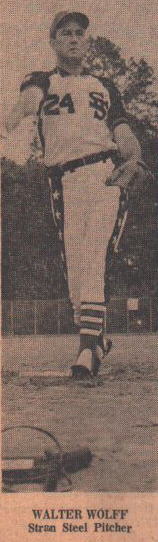
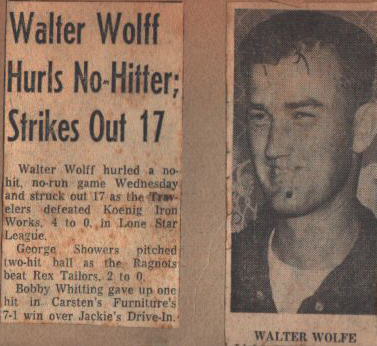
|
The Story
-- the softball career of Walter Wolff --
-- an incredible journey spanning 6 decades --

(click on thumbnail
for larger image)
********************
Table of Contents:
The Early Days
 There
once was a tall, skinny kid from Bellaire. With a natural gift of
athletic prowess, he was, like a lot of his teenage buddies at the
time,
very involved in organized sports. There
once was a tall, skinny kid from Bellaire. With a natural gift of
athletic prowess, he was, like a lot of his teenage buddies at the
time,
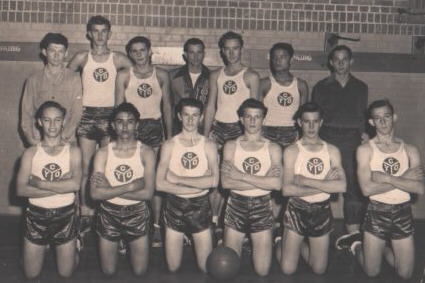
very involved in organized sports.  A
key influence in those days shortly after the second World War was the
Catholic Youth Organization (CYA), where he played both basketball and
softball. It was at this very young age when he discovered his
special skills
for the sport of fast-pitch softball (and who'd even HEARD of
"slow-pitch"
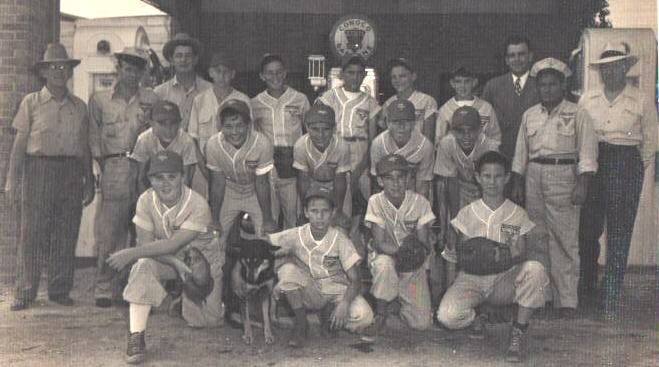
in those days?). His very first softball team was a team called the
Conoco Juniors, sponsored by a Conoco gas station. He started playing
in the Houston Chronicle softball tournament, an annual end-of-summer
event
sponsored by the local newspaper, at the young age of 16. A
key influence in those days shortly after the second World War was the
Catholic Youth Organization (CYA), where he played both basketball and
softball. It was at this very young age when he discovered his
special skills
for the sport of fast-pitch softball (and who'd even HEARD of
"slow-pitch"
in those days?). His very first softball team was a team called the
Conoco Juniors, sponsored by a Conoco gas station. He started playing
in the Houston Chronicle softball tournament, an annual end-of-summer
event
sponsored by the local newspaper, at the young age of 16.
Prime Time
 Many
teams and many years later, Walter Wolff was beginning to make a name
for
himself and was quickly becoming to be known as one of hottest young
softball
pitchers in the state of Texas. Many
teams and many years later, Walter Wolff was beginning to make a name
for
himself and was quickly becoming to be known as one of hottest young
softball
pitchers in the state of Texas.  By
the time he was 25, he had never lost a Houston Chronicle tournment
game,
and had won 22 straight tournament games. One of his first glorious
successes in the limelight was in 1959, when he received the Houston
Chronicle
tournament's Outstanding Pitcher Award. His
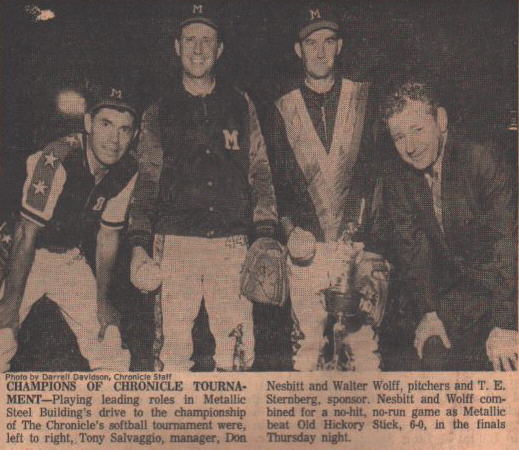
Metallic Steel Building team were Houston Chronicle
champions
in 1966. His 6ft.-6in., 240lb. mound presence and 80mph pitches
brought fear to the average batter. He became widely known for his
trademark toothpicks, that he chewed on the mound while pitching.
Perfect
games and no-hitters were becoming commonplace, and strikeouts were so
numerous, oftentimes surpassing 15 in a typical 7-inning game, that it
was virtually impossible to keep track of them all. Although career
statistics are unavailable, by the end of the 1968 season, Walter had
played
in 9 successive American Softball Association (ASA) state championship
tournaments and had compiled a major city win-loss record of 461-53,
while
averaging 12 strikeouts per game. During the next 3 seasons ('69-'71),
he won 89 games and lost only 33, while recording 37 shutouts. By
the time he was 25, he had never lost a Houston Chronicle tournment
game,
and had won 22 straight tournament games. One of his first glorious
successes in the limelight was in 1959, when he received the Houston
Chronicle
tournament's Outstanding Pitcher Award. His
Metallic Steel Building team were Houston Chronicle
champions
in 1966. His 6ft.-6in., 240lb. mound presence and 80mph pitches
brought fear to the average batter. He became widely known for his
trademark toothpicks, that he chewed on the mound while pitching.
Perfect
games and no-hitters were becoming commonplace, and strikeouts were so
numerous, oftentimes surpassing 15 in a typical 7-inning game, that it
was virtually impossible to keep track of them all. Although career
statistics are unavailable, by the end of the 1968 season, Walter had
played
in 9 successive American Softball Association (ASA) state championship
tournaments and had compiled a major city win-loss record of 461-53,
while
averaging 12 strikeouts per game. During the next 3 seasons ('69-'71),
he won 89 games and lost only 33, while recording 37 shutouts.
Another defining moment of Walter's career was the
time
his team played the world-famous pitcher Eddie Feigner and his 4-player
"King & His Court"
softball team in the Houston Astrodome. Eddie, who is generally
regarded
as the best fastpitch pitcher in the world and who has been doing world
tours for over 50 years, has gained quite an astounding reputation for
his pitching showmanship, including being able to pitch behind his
back,
through his legs, blindfolded, and even from 2nd base. His 4-player
team usually has no problem beating regular 9-player teams.
If there is any one term that most aptly describes
Walter's
softball career, it would be "staying power." He continued
his career well into his 60s, being active in Old-Timer's softball (45
years and older) and playing mostly with Houston's Latin American teams
in his later years.
Interviewed just prior to the start
of the Chronicle's 50th Softball Tournament, it
was disclosed that Walter had played in every Chronicle
Tournament since 1947. This amazing article entitled
"Old-timers haven’t gone soft on softball" (page 1/page 2), written by Jayne Custred, appeared in the
Houston Chronicle newspaper in July 1988. Her story was a
heartwarming glimpse into old-timer fastpitch softball players like my
dad, whose careers spanned several decades and were still playing the
game with passion.
At the time of the article, Dad was already a "young" 55-year-old,
pitching on a 45-and-over team. If you have any interest in the history
of fastpitch softball in Houston, Texas, you'll probably want to have a
look when you get a chance.
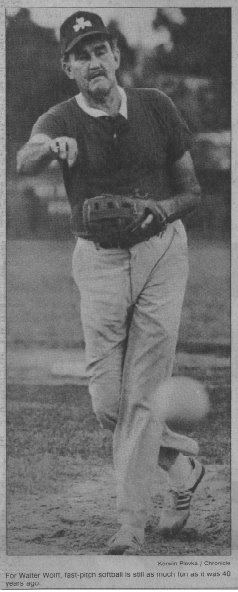
Photo caption above reads: "For Walter Wolff, fast-pitch softball is
still as much fun as it was 40 years ago." (from July 1988 Houston
Chronicle article, "Old-timers haven’t gone soft
on softball." (page 1/page 2))
World Fame
 The
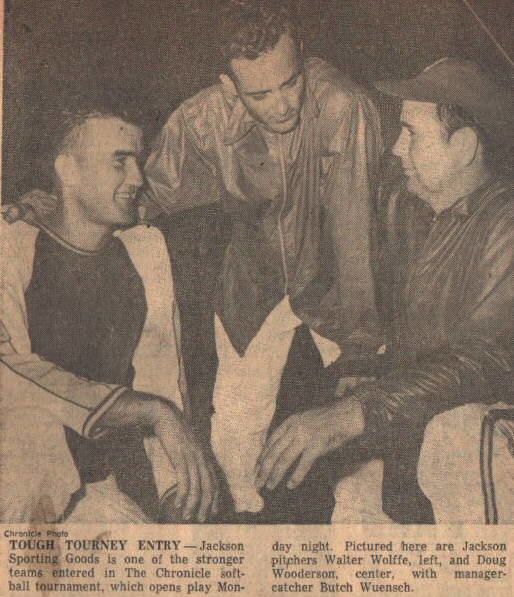
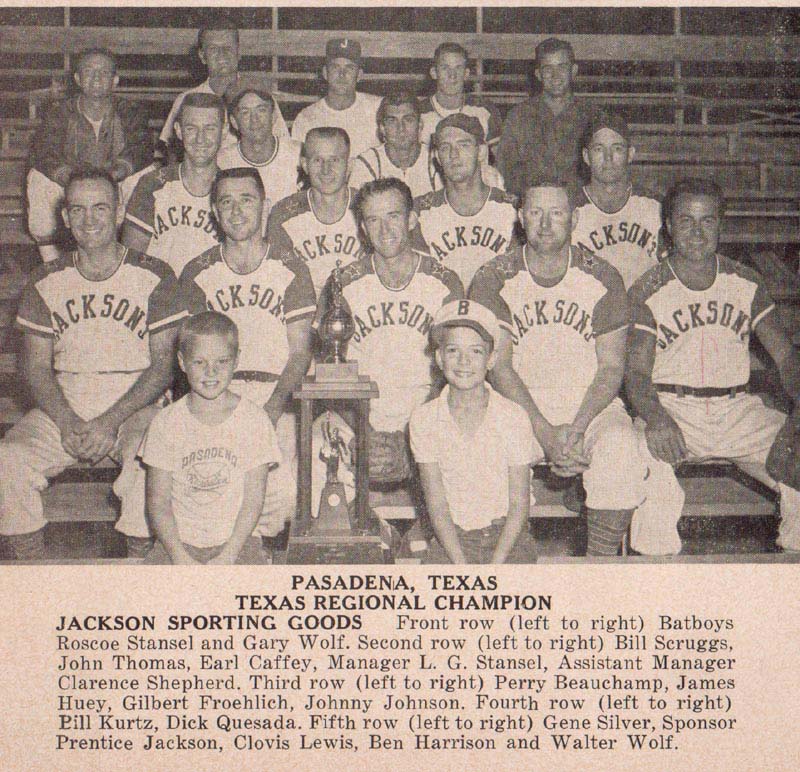
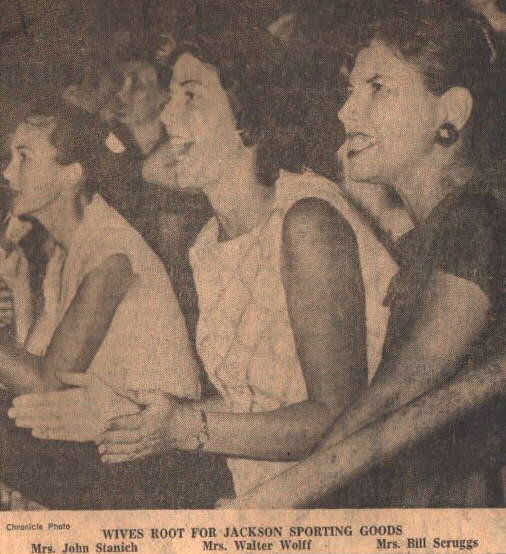
first step onto the world stage came in 1961 when Walter's Jackson
Sporting
Goods team won the ASA state
softball
championship
in San Antonio, Texas. He was the winning pitcher in the final
game and was named to the all-tournament team. Winning the state
championship
qualified them for a trip to the ASA World Softball Tournament in
Clearwater,
Florida in September. The
first step onto the world stage came in 1961 when Walter's Jackson
Sporting
Goods team won the ASA state
softball
championship
in San Antonio, Texas. He was the winning pitcher in the final
game and was named to the all-tournament team. Winning the state
championship
qualified them for a trip to the ASA World Softball Tournament in
Clearwater,
Florida in September.  In
30 innings of pitching in Florida, Walter gave up only 4 runs and won a
15-inning game against Mesa, Arizona. His Jackson Sporting Goods
team repeated as state champions again in 1963 and won another trip to
the ASA World Softball Tournament in Clearwater. In
30 innings of pitching in Florida, Walter gave up only 4 runs and won a
15-inning game against Mesa, Arizona. His Jackson Sporting Goods
team repeated as state champions again in 1963 and won another trip to
the ASA World Softball Tournament in Clearwater.
Other major softball tournaments Walter has played
in
include:
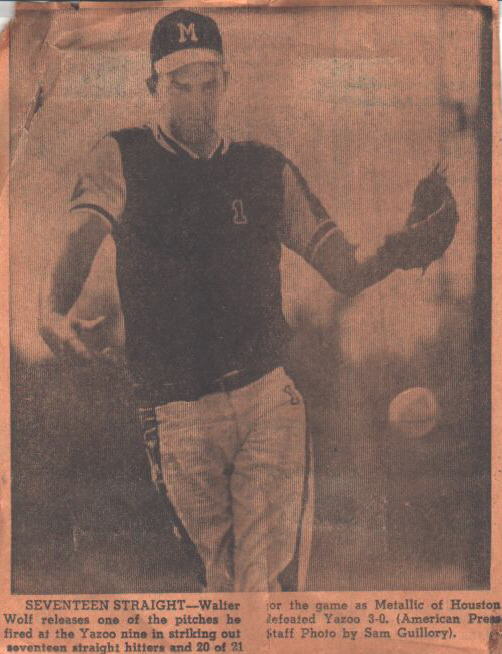
- 1965 Lake Charles, Louisiana Softball Association
Tournament
of Champions; Winner -- Metallic Steel Building; Winning
Pitcher -- Walter Wolff (struck out 20 of 21 batters, including 17
straight)
" I went to the Lake
Charles tournament in '65 when Walt threw an absolutely dominant
no-hitter against a good Yazoo team out of Baton Rouge, Louisiana.
I don't think any of their generally good
hitters got the ball out of the infield. Walter's rise ball looked like
a flat rock skipping off of a pond.
He had it really jumping and the Yazoo guys
were so far off of it (under it, naturally) they couldn't get a
good idea on how to adjust."
Lynn Meeks, former Bell Bonding teammate
(excerpt from his 8/16/2004 email)
|
- 1968 International Softball Congress (ISC) World
Softball
Tournament, Rock Island, Illinois
- 1970 ISC Southwest Softball Classic, El Paso,
Texas
- 1970 ISC World Softball Tournament, Fresno,
California
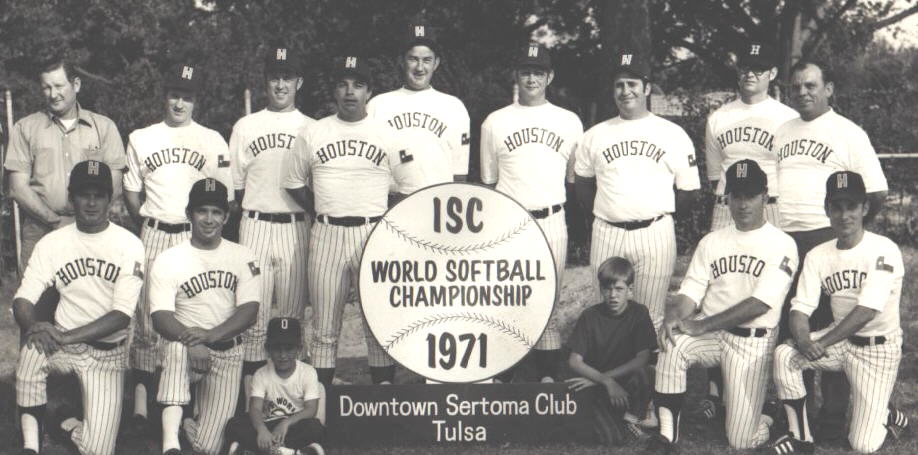
- 1971 ISC World Softball
Tournament,
Tulsa, Oklahoma
- 1971 Firecracker Invitational, Englewood, Colorado
- 1974 ISC World Softball Tournament, Sun City,
Arizona
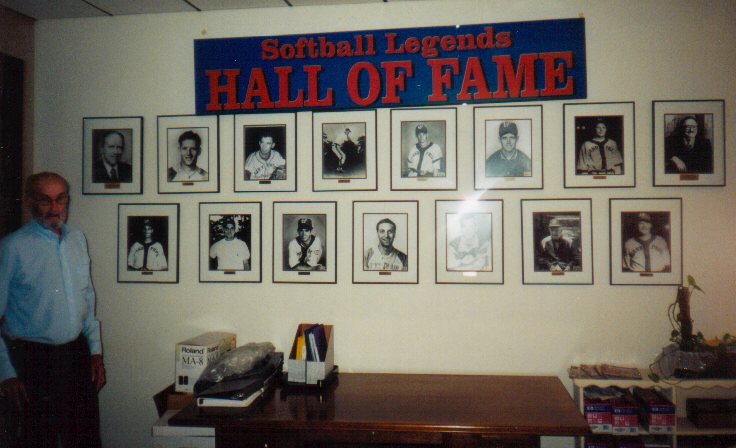
On October 10, 1986, Walter was inducted into the Softball
Hall of Fame in a ceremony in Houston, Texas.
International Goodwill Softball
Ambassador
Not only did Walter Wolff play in numerous
prestigious
tournaments on American soil, but he also had opportunities to display
his skills and spread softball camaraderie in international settings as
well. He played 3 times in Mexico, including in Mexico City, Tampico,
and the Mexican National Softball Tournament in Poza Rica in 1970.
Impressing
the local fans with his blazing pitching, he was once featured on the
front
page of a newspaper's sports section with these headlines -- "El Lobo
Does it Again" (Lobo means "wolf" in Spanish).
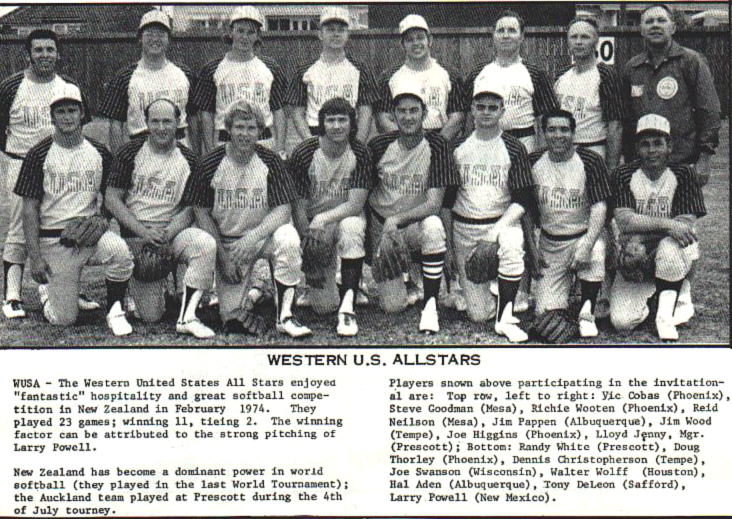
 Even
more impressive was his tour of New Zealand as a member of the Western
U.S. All Stars in February, 1974, traveling from city to city and
playing
the best teams in New Zealand, which is widely recognized as a dominate
power in world softball. Later that same year in July, the United
Softball Club of Auckland, New Zealand sponsored a tour of the U.S. by
their team. While in Houston, Walter's construction company served as
the New Zealand team's
local host and made all their arrangements, even sponsoring some of
their
festivities, including a big party thrown at the Wolff household. Even
more impressive was his tour of New Zealand as a member of the Western
U.S. All Stars in February, 1974, traveling from city to city and
playing
the best teams in New Zealand, which is widely recognized as a dominate
power in world softball. Later that same year in July, the United
Softball Club of Auckland, New Zealand sponsored a tour of the U.S. by
their team. While in Houston, Walter's construction company served as
the New Zealand team's
local host and made all their arrangements, even sponsoring some of
their
festivities, including a big party thrown at the Wolff household.
The following are the words of Jack Shanks, the New
Zealand
team's organizer, as recorded in his club's report of their 1974 U.S.
tour:
"Arrived in Houston to be met by those wonderful
people Nora and Walter Wolff. These people could pass as New
Zealanders.
The temperature was 95 degrees F., humidity about 70%, very hot, and as
we walked into the bus, were served a cold glass of beer out of a
9-gallon
keg in a drum of ice.
Things like this explain about these people
who think of everything. We were put up in a very new and modern
motel which was top class. On Friday night, we were treated to being
taken to the Houston Astrodome for a game of Houston Astros baseball.
This
is truly a great sight and shouldn't be missed by anyone traveling to
the
States.
On Saturday, we played very well to win 7-1.
Following
the game, Nora and Walter put on a real N.Z. party at their
house. Words
are hard to find to thank these people for such a warm gathering and a
great party. I am sure that all team members will always remember
that night. Nora went to a tremendous amount
of trouble to present an enormous meal of New Zealand foods, and to
feed
80 odd people speaks for itself.
On behalf of all members to
Nora and Walter Wolff, thanks a million."
Jack Shanks
United Softball Club of Auckland, New Zealand
January 13, 1975
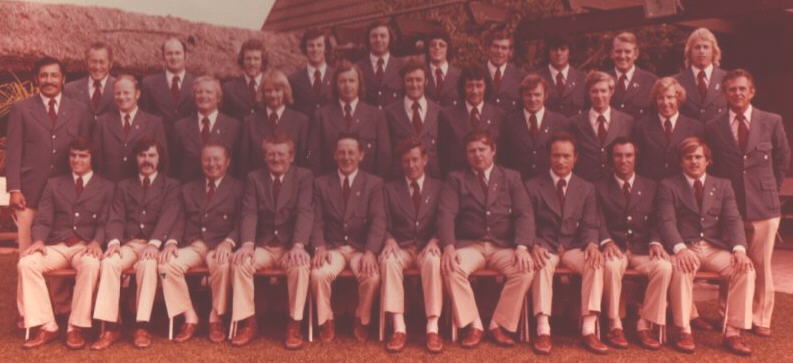
 (Click
on the photo to see the team picture) (Click
on the photo to see the team picture)
As a result of all his hospitality, Walter was
inducted
as an Honorary Member of the United Softball Club of Auckland, New
Zealand
in 1974. The letter of appreciation he sent to the United
Softball Club
is shown here.
The Teams
- Los Compadres Silver Bullets
- Eastwood ('88)
- White Glove ('72-'73)
- Bell Bonding ('69-'71)
- Stran Steel ('67-'68)
- Metallic Steel Building
('66)
- Doc's Cozy Cabins ('65)
- J.H. Rose Truck Line ('64)
- Jackson Sporting Goods ('59-'63)
- Steele Construction ('58)
- O.S.T. Fruit Store
- Welcome Inn
- Fox & Gates Saw Shop
- Southwestern Saw
- Westbrook Sales
- Rigsbee Hardware
- O.K. Drillers
- Travelers
- Bellaire Cardinals
- Conoco Juniors
The Pitches
 RISE
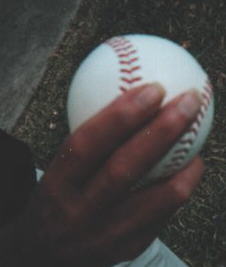
BALL -- In many respects, Walter's rise ball is
basically
an underhanded version of baseball's curve ball. The grip is almost
identical, with the index and middle fingers aligned up next to the
seams
at their narrowest point. Just before the ball is released at the
bottom of the windmill windup, the wrist must tilt slightly sideways
before
it snaps to direct the ball in a back-spinning, upward trajectory. In
so doing, the softball is released with all 4 seams at their widest
point
rotating end over end so as to get the most wind resistance possible.
Wow,
you should have seen this baby hop during the guy's prime. Talking
about some baffled batters....... RISE
BALL -- In many respects, Walter's rise ball is
basically
an underhanded version of baseball's curve ball. The grip is almost
identical, with the index and middle fingers aligned up next to the
seams
at their narrowest point. Just before the ball is released at the
bottom of the windmill windup, the wrist must tilt slightly sideways
before
it snaps to direct the ball in a back-spinning, upward trajectory. In
so doing, the softball is released with all 4 seams at their widest
point
rotating end over end so as to get the most wind resistance possible.
Wow,
you should have seen this baby hop during the guy's prime. Talking
about some baffled batters.......
 DROP
BALL -- As explained by Walter, the grip for the drop
ball
is not so critical, as long as the ball is released off the fingertips,
again so that all 4 seams at their widest point are rotating end over
end
-- only in this case, obviously in a rotation opposite that of the rise
ball, giving it a forward-spinning, downward trajectory. In his case,
he grips the ball with his index finger cocked back and with the index
fingernail planted against a seam, to give it more control. The most
critical thing about the delivery of the drop ball is that the foot
which
is planted just prior to the release of the ball (the left foot for
right-handed
pitchers) should take a slightly shorter step (about one-half of a
foot-length)
than with a regular pitch. This places the upper body in a more
slightly
forward, off balance posture, giving more power to the actual drop ball
delivery, accentuating its downward trajectory. DROP
BALL -- As explained by Walter, the grip for the drop
ball
is not so critical, as long as the ball is released off the fingertips,
again so that all 4 seams at their widest point are rotating end over
end
-- only in this case, obviously in a rotation opposite that of the rise
ball, giving it a forward-spinning, downward trajectory. In his case,
he grips the ball with his index finger cocked back and with the index
fingernail planted against a seam, to give it more control. The most
critical thing about the delivery of the drop ball is that the foot
which
is planted just prior to the release of the ball (the left foot for
right-handed
pitchers) should take a slightly shorter step (about one-half of a
foot-length)
than with a regular pitch. This places the upper body in a more
slightly
forward, off balance posture, giving more power to the actual drop ball
delivery, accentuating its downward trajectory.
Additional Drop Ball tips from the Fall '67 edition
of
"Softball Illustrated," the nation's first softball magazine can be
found here.
Comments from former Softball Friends
Links to other Softball Web
Sites (updated
June 20, 2011)
Notes:
(1) All of the small thumbnail photos on this
page are clickable, opening up into a larger image......
(2) Background music: one of Walter's favorite
songs,
"Ring of Fire" by Johnny Cash
Back
to Home
|